

Pandin’s Paradox: The only paradox still in the rules and surrounding Convoy and Support orders. Basically, if the convoying fleet is disrupted, the convoy fails, making the army’s move contingent on the success of the convoy move. Unlike a bounce resolution, we now have to see if the convoy succeeds before we can move the convoyed army. So, if we decide it does succeed and transport the army across the water, it can have an impact on the adjudication we had to perform to determine if the convoy succeeded. Confused? You will be… if you ever come across it!
Paper Age: The era of Diplomacy from the first publication of the game, 1959. In this age, Diplomacy was most often played by post, with everything published on paper. Succeeded by the ELECTRONIC AGE, possibly starting in 1988 with the first publication of Dipzine ELECTRONIC PROTOCOL.
Paradox (1): When a rule in Diplomacy can produce two ‘correct’ outcomes. It’s rare that any paradox will occur, frankly, and there is no real agreement on how they should be handled, so the House Rules or Site Rules should explain how they’re dealt with.
Paradox (2): Pretty much the same as above except this occurs in variants that no longer maintain simultaneous orders. Silly idea. Diplomacy is about simultaneous orders!
Paranoid player: In the FTF Hobby, someone who insists on being there when their drink is being poured.

Paris Method, The: When playing in an arena Diplomacy final (of championship) game, or a Top Board at a tournament, the Paris Method might be used to not only allocate powers but also decide the outcome of the game in a draw. Basically, the players are first ranked in order based on a given criteria. Starting with the top-ranked player, they decide when they will choose the powers they pick. The lowest ranked player will be first on the list. Then, the second-lowest ranked player decides whether they will choose their power before or after the lowest ranked player. Next, the third-lowest ranked player decides whether they will pick their power before anyone else, after everyone else, or between the two players already on the list. This process continues until all players have selected their choice position. Finally, the player top of the list chooses their power, then the second player, and so on until the last player on the list is left with Italy (or whichever power remains unselected). If the game ends in a draw, the player who chose their power latest wins the game.
Passing a letter: Alternative name for REMAILING.
Pasta la Vista alliance: An alliance featuring France, Austria and Turkey. Named because it will see the end of Italy.
PBEM: See PLAY-BY-EMAIL.
PBF: See PLAY-BY-FORUM.
PBM: See PLAY-BY-MAIL.
Permanent Substitute: A player who has to leave a game might nominate someone, presumably who has agreed to it, to replace them in a game… if the GM allows this.
Perpetual Orders: A set of orders that are issued once and which the GM should take as being repeated each phase, unless countermanded. Easy for the player, a lot of work for the GM.

Phantom orders: Orders that come from somebody out of the game, or from an automated system if a player NMRs. They may not be neutral.
Phase: A stage in the game when various actions can be carried out. See DIPLOMACY PHASE, MOVEMENT PHASE, ADJUDICATION PHASE, ORDER WRITING PHASE, RETREATS PHASE, ADJUSTMENTS PHASE, WINTER TURN.
Phony letter: In the Postal Hobby, a letter written to be sent to an ally that contains information that the ally might decide should be forwarded to another player. The aim might be, in agreement with your ally, persuade the third player of a false set of moves you might make.
phpDiplomacy: Original name for WEBDIPLOMACY.
Pinned to the wall: A unit that is positioned on the board that isn’t useful and can’t get out.
Play-by-Email (PBEM): A format for playing Diplomacy that sees communications between players, and between players and the GM, through email.
Play-by-Forum (PBF): A format for playing Diplomacy that sees communications between players, and between players and the GM, through a Forum or chat site..
Play-by-Mail (PBM): A format for playing Diplomacy that sees communications between players, and between players and the GM, through the post.

Playdiplomacy: Online Diplomacy games site, first launched in 2007. Once the largest Dip site, and had a thriving Forum. However, following a cyber attack the Forum was removed because it was found to be the way the attack got into the site. Since then, with no moderation, the site has sadly been in decline. Still a good site on which to play games: https://www.playdiplomacy.com/
Playing too much Diplomacy: Can there be such a thing? Oh, yes. Playing in more than three games at once? Yep. Dreaming about Diplomacy? Definitely. Lying in bed with a partner, your hand on their stomach, considering moving it elsewhere but not doing so because (a) you can’t remember the abbreviation for said destination or (b) you can’t get there without support anyway? Waaaaaaaay too much Diplomacy.
Point and Click: A method of entering orders on most Diplomacy sites. Players point their cursor at the space their unit is in, click on it, and then select an order. So, if you want to order F Lon-ENG, you’d (1) click on London, (2) select the order MOVE from a drop-down menu, then (3) click on the English Channel.
Polish Corridor: Silesia and Prussia.
Postal Diplomacy: Another name for PLAY-BY-MAIL Diplomacy.
Postal Diplomacy Zine Archive: An archive of US Dipzines, maintained by Doug Kent. https://whiningkentpigs.com/DW/kent/diplomacyzinearchive.htm
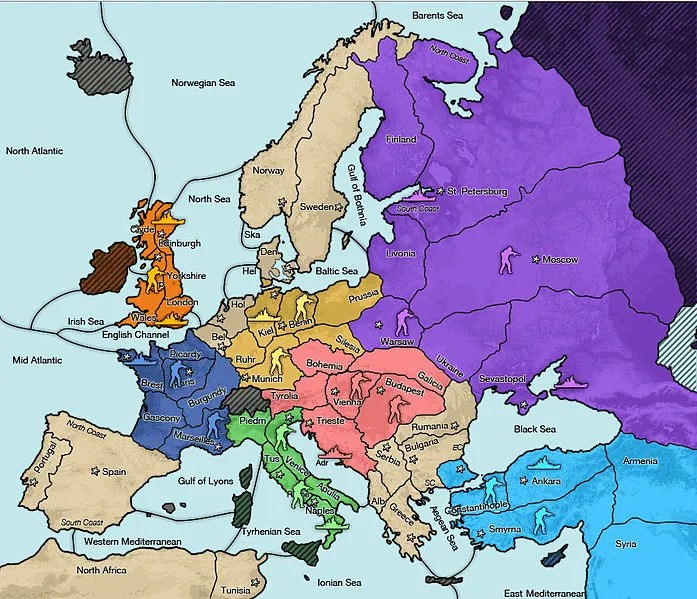
Power(s): Seven playable countries in Diplomacy.
Preference list: When entering a game of Diplomacy you might be asked to provide a list of the powers you would like to play in order of preference. Allocation then proceeds in rounds. Round one allocates powers to any player that chose a unique power; any players who chose the same power as someone else do not get their choice. Round two sees any remaining players move to their second choice power. If they selected a unique power that hasn’t already been allocated, they play that power. If the second choice power has already been allocated, or two or more players have the same power as their second choice, they are not allocated a power. This process is repeated until all powers have been allocated. If only one player hasn’t been allocated a power, they receive the final power. In the rare event that players are not allocated powers in this way, the remaining powers will be allocated to players that had them highest up on their lists or, failing this, randomly.
Preferences: A system of allocating powers on Playdiplomacy that follows the system described under PREFERENCE LIST. However, on Playdip, players select only three powers; this usually works because this will normally be sufficient to allocate powers.
Press: Written messages sent between players in a game.
Prosnitz Manoeuvre: Alternative name for KINGMAKING.
Prospects: The ratio on a player’s SCs to the number of SCs they need to solo. A player on 12 SCs needs 6 SCs to win, so their prospect of winning is 2-1.
Protected Game: On Playdiplomacy, a Protected Game has protection from an NMR or a SURRENDER. If a player NMRs the game deadline will be extended one additional deadline length. The players all have longer to negotiate and get their orders in. Is a player SURRENDERS or is AUTO_SURRENDERED the game is extended by a deadline length so that another player can enter the game and catch-up.
Protégé alliance (1): Alternative for BIG BROTHER ALLIANCE.
Protégé alliance (2): An alliance between an experienced and skilled player and a novice.
Province: Alternative but inaccurate name for space. Inaccurate because ‘province’ indicates an area of land only, whereas it is often used for sea spaces too.

Provisional orders: A set of orders that a player enters or submits at the start of a Diplomatic Phase. This allows the player to have some orders in place should they somehow miss the deadline.
Proxy orders: Orders entered for Player A by Player B, with or without Player A’s permission. Actually, usually with: a GM wouldn’t accept orders from one player for another’s units unless they’d been asked to do so by the player who has surrendered their orders. A form of JOINT ORDERS and, like joint orders, they would be revoked if a separate set of orders was received from either player following the agreement.
Pseudo stalemate line: A line which isn’t actually a stalemate line but is close enough that players either choose to accept it as one because it would take too long, or be too risky, to break, or because they think it is a real stalemate line because they’ve been persuaded it is.
Public Press (1): Written messages sent from one player to all the others in a game.
Public Press (2): A Diplomacy variant that allows players to communicate only in public.
Purn: Threatening some undefined action against someone else for some undefined reason.
Puppet: Another name for DIP BITCH.

Pussycat play: A game of Diplomacy played using deadlines that are much too short to play the game effectively. With longer deadlines, it involves players who are constantly demanding that others get their orders FINALISED quickly. Pussycat players are those who don’t want to waste time talking to others and are only interested in getting the game moving. Play GUNBOAT, fools!
Quick retreat: A situation where a unit in a far away non-SC space is dislodged, often by an ally, usually in a Fall turn, enabling the owner to disband it rather than retreat it and hence build it in a home SC.
 THE DIPTIONARY