
IN AN EARLIER POST, I WROTE ABOUT THE KINGMAKER, A PLAYER WHO THROWS THEIR GAME AWAY TO LET SOMEBODY ELSE WIN THE GAME, SOMETHING OF A STRANGE THING TO DO – A CRIME OF PASSION, PERHAPS?
Kingmaking can be defended as being the last gasp of a player who has been stabbed and seeks that sweet vengeance but lacks the facility to achieve this themselves. In lieu of this, they turn to another, more powerful player and attempt to help this third player to win the game. They throw themselves out with the bathwater.
It’s also been defended as more layered than this kamikaze portrayal. Rather than being self-sacrificial, the player may be attempting to set themselves up to survive, while using their chosen ‘king’ to destroy their victim. Frankly, this isn’t an act of kingmaking; this is something different. This is something close to the actions of a Janissary.
Why ‘Janissary’?
The term ‘Janissary’ in Diplomacy is, like ‘Kingmaker’, borrowed from history, specifically the history of the Ottoman Empire, as represented by Turkey in Diplomacy.
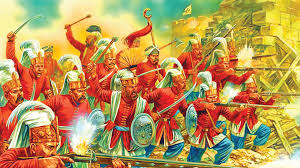
Janissaries were elite troops with one task: defend the Sultan, and hence the empire. Originally formed from kidnapped young people from the Balkans, who were converted to Islam and trained to the highest levels, they were the first form of a standing army in Europe. However, they also became a political force, and led the overthrow of Sultans they weren’t favourable towards.
It isn’t immediately clear how this converts to the use of the term in Diplomacy (which I’ll explain below). This isn’t about an elite force, however; it is about the impact this force had on the governance of the Ottoman Empire. In Diplomacy, it is the act of playing to further another player’s position in the game.
The Janissary in Diplomacy
There are few accessible articles on the Janissary in Diplomacy. In The Tangled Web We Weave, a short-lived UK Dipzine published by Stephen Agar in 1997, Paul Barker wrote what is the most definitive article on the ‘Janissary’. Just ignore that he limits the term to a player who aids the Turkish player. If the term were limited to such a narrow definition, it wouldn’t have survived as a widely recognised and used term today.
BrotherBored wrote about the Janissary in his post “The Diplomacy Double Backstab” from his self-named blog. Again, this includes a definition of what a Janissary is. (There is a link to another blog post, which suggests that being a Janissary might not be a great idea!)
In his article (which I presume was published in The Diplomatic Pouch originally) on “The Grand Alliance“, Roger Yonkoski warns players seeking to set up a GRAND ALLIANCE. Here, the Janissary is recruited by the player attempting to solo, though this is not always how the Janissary agreement is formed.
What is a Janissary?
Hopefully, you’ve been polite enough not to follow those links before reading the rest of the post! OK, if I didn’t think you’d do that, I’d provide the links at the end! So you have probably read some interesting stuff about Diplomacy, as well as having a good idea about what a Janissary is.
As I said above, Paul Barker links the Janissary to a player who supports the Turkish player to grow their empire. He does say, towards the end of the article, that the principles of the Janissary alliance can be adapted to other powers, but he also states that it is “particularly apt” to the Turkish situation. Why?
Well, Turkey is often referred to as being in a ‘BOX‘. A true corner power, Turkey is faced with limited options to grow beyond the EARLY GAME. Russia to the north, Austria just the other side of the BALKANS, Italy to the west and challenging for control of the seas in the eastern Mediterranean. It is quite common for Turkey to capture Bulgaria… and then be stymied by an alliance of other powers. Even when Turkey prospers and gains more spaces they still have to find a way out of the box.
Come the MID-GAME, which is when a Janissary alliance is formed, Turkey will seek an alliance with a weaker power. BrotherBored calls this power “half-destroyed”. They reach out to a player who is facing elimination, usually sooner rather than later, and this player becomes Turkey’s ‘Janissary’. They work together, pressing forward to challenge the power(s) sealing Turkey’s box. Turkey grows; their Janissary survives, although often limited to a small number of SCs. It’s common for the Janissary to gain SCs from other players, while Turkey feeds off the Janissary’s SCs, while growing from new gains themselves.
This type of agreement is typically formed in the early Mid-game, and can often be sought by England, who faces a similar problem to that of Turkey, although England’s ‘box’ is less restrictive and often more to do with the problem of getting armies onto the Continent, and is something I’ve taken to calling the DUNKIRK BOX (or, at least, I will do – just came up with that name now!). France may face something similar, especially if facing a GUILLOTINE alliance (E/G/I); and Russia might face it in the south (again, the Balkans) or the north (Scandinavia), and perhaps – much more problematic – both! The INNER POWERS – Germany, Austria and Italy – usually have alternatives if they are blocked from expanding in one area of the board, although Italy can find themselves in a similar situation again, which I call the SPAGHETTI HOOP.
A Janissary agreement could well be formed between any two powers on the board, however, and is certainly possible in the later stages of the Mid-game. As a power grows, there will usually be a solidifying of an alliance to baulk that growth. This isn’t necessarily a Grand Alliance; it could well be that it is two or three players who act together to halt that growth, without necessarily involving all the surviving players. Besides, the Grand Alliance usually occurs in the ENDGAME, when one player is closing in on the solo.
A Janissary may not be a neighbouring power, either. It is just as likely to be a power on the other side of the board, when both players have a common enemy in between, eg. England and Austria, with a strong Germany. In this situation, the strong power – say, Austria – will offer to help England survive by attacking Germany, taking the pressure off England, as long as England works with Austria to ensure their (England’s) survival and will continue the alliance with Austria further into the game.
The one condition that remains in a Janissary agreement is that the Janissary is a weak power, close to elimination and likely to face this sad end without the intervention of a stronger power. The Janissary, then, has one objective: survival to the end of the game, and a place in a draw. The strong power… well, their objective will be something quite different!
When a ‘Janissary’ ISN’T a Janissary?
A Janissary isn’t the same as a player issuing FIELD MARSHAL ORDERS. This is when one player signs over control of their units to another player. It might include this, but it usually doesn’t. While the Janissary, the weaker player, may well simply order what they are told to order, the Janissary agreement is more like a traditional alliance. It involves communication, strategic and tactical discussion.
It is designed to help the stronger power to continue to grow. The idea for this player is that the Janissary supporting them is able to use their units to help this to happen. The Janissary will be on the frontline, either alongside the stronger player’s units or attacking the player they are targeting.
For the Janissary, the objective is to keep themselves in the game, to survive in the short-term and, long-term, to be around at the end of the game to be a part of a draw. They’re not a Kingmaker; the aim isn’t to help their partner to solo but to achieve some sort of result at the end for them.
Danger! Danger!
The main danger is squatting quietly behind the Janissary. While they are using their units, probably sacrificing SCs to the leading partner as they capture further SCs themselves (albeit not on a one-for-one basis if they’re going to stay around should something go wrong), the stronger power is growing. At some point, what is to stop the strong power pouncing on their Janissary to achieve the solo? Frankly, nothing.
The Janissary should, therefore, not stop communicating with the other players in the game. There’s no reason that this shouldn’t be going on, no matter what their partner will say. After all, the other players should be trying to communicate with the Janissary, too, trying to break this alliance.
For the stronger power, the threat is the Janissary suddenly withdrawing their support. All the Janissary wants is to escape elimination, initially. Once that has been achieved, once the player who was threatening to eliminate them has been defeated or weakened sufficiently to prevent that from happening, why shouldn’t they reconsider their position? After all, they must recognise the threat of the ultimate, game-winning stab that could well be coming their way. Mustn’t they?
To go back to history, there is the example of Sultan Mehmed II, who launched an “Auspicious Incident‘ in 1826. In this, with the Turkish Janissaries opposing the modernisation of Turkish armed forces and refusing to change, Mehmed II ordered his artillery to fire on the Janissary barracks. The survivors were executed. That was the end for the Janissaries.
Very often, it is a similar end which meets the Janissary in Diplomacy.

 THE DIPTIONARY